
Become a Systemic Financial Professional™
Communicate therapeutically without becoming a therapist.
Scholarships are available. Contact hello@sfp.network to learn more.
Financial professionals don’t need to be trained therapists. The first step in therapeutic communication is being willing to listen and to empathize with clients.
Maybe “soft skills” sound easy to you…but have you tried to put systemic knowledge into practice? It is oftentimes much harder than it seems.
Plus, let’s not forget about ethics and boundaries. If advisors are not licensed therapists, they need to be able to facilitate seamless referrals when sensitive issues do arise, the same way they would refer a client to an attorney or certified public accountant if they needed financial assistance beyond one’s abilities.
This all points toward understanding the client’s system.
There are an increasing number of training programs centered around the psychology of money, financial therapy, behavioral techniques, and the like. Getting to the root, “thera-“ means “to heal” whereas “-logy” means “study of.” The Systemic Financial Professional™ understands this differentiation and can apply the best technique given the situation. This training program serves as the platform to the integration of therapeutic communication and personal financial management and planning.
From a 2026 SFP Training Attendee:
“First and foremost, thank you for all the work you put into this course! There is so much great material here, and the group discussions helped bring it together on an even deeper level. I found the multidisciplinary perspectives that each person brought particularly interesting and valuable. During the live sessions you struck the perfect balance between offering additional information through the slides and creating space for us as participants to help facilitate the discussions, which I think allowed for the conversations to then unfold very naturally. Not all facilitators are comfortable allowing for that openness nor do they have the ability to navigate the conversations (wherever they may go), you do this effortlessly.
The materials you provided are invaluable, this is part of what makes the course so much different from any others in my opinion. You not only teach the content, but you provide very clear applicable resources that anyone can start using. This is what people are looking for, they want to know how to start doing the things they are learning. The content - as someone who is familiar with family systems I still found myself going back and rereading certain sections, I loved your perspective and framing of the topics. So even if someone is familiar with the content, I think there is still something to be learned and gained from going through this experience.”
-
The Systemic Financial Professional™ (SFP™) designation is conferred and maintained by the Institute for Systemic Financial Professionals™.
What is Systemic Financial Planning?
The CFP Board outlines the seven steps to the financial planning process starting with understanding the client’s financial and personal situation and ending with continuous monitoring of the financial plan. Within each of the original seven steps, there is opportunity to expand the perspective to incorporate systemic elements. Applying a systemic approach to financial planning requires self-awareness of how you, the professional, are part of the client system and how you influence outcomes both explicitly and implicitly through your words, tone, and actions.
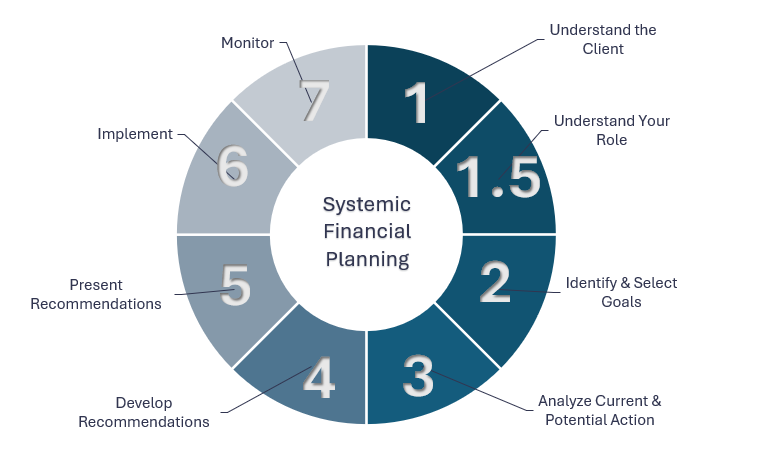
1 Systemic Approach to Understanding the Client: To get to know a client’s circumstances starts with understanding the “system.” The system includes your client and the important people in their life. A systems approach involves listening with your eyes to understand what is not said. To fully understand a person means paying attention to the process and the content.
1.5 Systemic Approach to Understanding Your Role in the System (a new systemic step to the traditional process): Once you have a solid understanding of the client’s system, you start to recognize how you are part of the system, too. In this step, you will increase your self-awareness to know how your emotions and biases influence client interactions and outcomes.
2 Systemic Approach to Identifying and Selecting Goals: To identify goals means understanding the “why” or values held by clients. No goal will be followed unless it is authentic to the client. A systemic approach to goals focuses on desirable outcomes that align with the client’s values. Possible outcomes that clients may identify include better financial wellness, living more authentically, and better communication with family/"the system" about money.
3 Systemic Approach to Analyzing Current and Potential Action: Pay attention to the emotional reactions with your conversations with clients and be ready to pause if the clients’ mentality prevents them from hearing what you are saying. In this step, you can manage emotional reactions through careful tools and discussion prompts.
4 Systemic Approach to Developing Recommendations: A Systemic Financial Professional™ sees more of what is going on with clients’ lives. As a result of this expanded perspective, be sure to recognize your limits and make referrals that are utilized by the clients. A recommendation may be to collaborate with other professionals or to make a referral to an outside professional to complement the work of financial planning.
5 Systemic Approach to Presenting Recommendations: Small changes are more likely to be followed than massive shifts in current behavior. Consider a staged approach to your recommendations.
6 Systemic Approach to Implementing Recommendations: When implementing goals, it is important to keep the client’s readiness for change at the front of mind. Tailor communication to the appropriate stage for the client’s readiness for change.
7 Systemic Approach to Monitoring the Plan: Financial planning is an ongoing process and monitoring client systems is just as dynamic. When reviewing progress toward goals, take process notes to capture what is not being said and note changes to the client system.
Why the SFP™?
The Systemic Financial Professional™ Foundations Training provides financial professionals with the knowledge, skills, and experience to understand and help clients achieve financial wellness.
Borrowing from the Dali Lama, “Our prime purpose in this life is to help others. And if you can’t help them, at least don’t hurt them.” The Institute for Systemic Financial Professionals™ offers educational resources, skills training, and professional support to financial professionals wanting to enhance their awareness and interventions in family systems.
Dr. Brian Portnoy, CFA
Founder & CEO, Shaping Wealth
As the practice of financial planning is changing dramatically, there is a large opportunity for advisors to upskill in the practical psychology of understanding their clients, the family and relational dynamics in which their clients are embedded, and the impact of money throughout.
The new initiative by Dr. Sonya Lutter, the Institute for Systemic Financial Professionals™, solves a critical training need for an industry searching for ways to undertake true “human-first” financial guidance. Dr. Lutter’s combination of theoretical mastery and practical savvy are a perfect recipe for driving the creation of this needed and inspiring program.
Any advisor seeking to deepen their practice of holistic financial advice should strongly consider earning the Systemic Financial Professional™ designation.
Didine Erskine, CFP®
“Listening to you speak today was both inspiring and affirming. You have such a grounded presence, and it’s clear that who you are with us as students is exactly who you are in front of the industry. Your work resonates deeply with me because you speak honestly and openly about things I often feel but don’t always know how to express.
While I wouldn’t call myself a counselor, I’ve spent most of my career surrounded by men, many of whom focus heavily on the technical side of the conversation, because for them, that’s what closes the deal. I offer the technical too, of course, but what really creates a connection in my work is something softer, more human. Clients often tell me they feel heard. That’s what stays with them.
I’ve found that when I bring calm and clarity, it eases their stress, because if I’m not worried, they’re not worried. I adopt a “we’ve got this” attitude, and it changes the entire tone of the relationship.
So yes, what you said about the industry shifting isn’t just theory-it’s real. I’m living it. And now, more than ever, I see how vital it is that voices like yours are helping to guide that shift. Thank you for giving words to what so many of us have felt all along.”
Are you a Behavioral Wealth Specialist, Coach, or other professional in the counseling/therapy side of things?
A SFP Training Attendee working in mental health said:
I highly recommend this program, it was an amazing learning experience! For mental health professionals, finding a program that brings to life the application of your training and experience in the context of supporting financial well-being is rare. This program expands your understanding and awareness of the dynamics of money and relationships through a systemic lens. And, you're learning all of this from an expert, Dr. Lutter, who has researched and practiced this approach! For financial advisors, this program bridges the gap between financial planning and the realities of how clients actually experience money, and teaches strategies for navigating personal dynamics with money while staying within the boundaries of your expertise.
Who Can Sit for Certification
The Systemic Financial Professional™ is a level-up certification for financial advisors, planners, coaches, educators, and financial therapists. Individuals must demonstrate their financial competency by holding another designation, such as the Accredited Financial Counselor®, Certified Financial Planner®, Certified Public Accountant®/Personal Financial Specialist, Chartered Financial Analyst®, or equivalent.
Steps to Certification
1. Complete the Systemic Financial Professional™ Foundations Training
$5,000 Intro price of $2,500
5 modules
Experiential learning through live lectures, discussion board interaction, and weekly challenges.
Small cohorts facilitate conversations that benefit you directly.
2. Pass Exam
The exam is completed through a proctored, online platform utilizing multiple-choice testing and written case studies.
3. Engage in Ethical Behavior
Commit appropriate focus to training.
Review and agree to the SFP™ Code of Ethics.
Be in good standing with the governing board of primary designation.
4. Be an Active Learner
Participate in collaborative learning.
Complete 15 hours of Continuing Education Credit per year, with at least 10 credits from ISFP.
Have you ever felt like you were missing something in your client work?
Have you ever went searching for something “more?”
Preview the Curriculum —>>
An elemental thing that financial professionals tend to lack relative to other established professions is a theoretical and empirically sound framework. By layering family systems theory with the traditional financial planning process, financial professionals are equipped to handle emotional and behavioral issues that come their way. That’s what the Systemic Financial Professional™ Foundations Training is all about.
-
The financial planning process (according to the CFP Board) starts with Understanding the Client’s Personal and Financial Circumstances. In addition to the financial data that is a natural part of the planning process, the personal elements are typically limited to basic demographic data. A systemic process brings in that missing element of family system dynamics.
Words like “holistic” or “comprehensive” could describe the process of understanding where the client is coming from. A systems process goes a bit further to understand the core of the issue. In this section, you will learn how to listen with your eyes to understand what is not said.
-
Step 1.5 is NEW to the traditional financial planning process. A key element of applying a therapeutic approach is knowing that YOU are part of the system. “You can only take the client as far as you have gone,” people say. This is it. Understand your role to better manage client dynamics and outcomes.
A systemic process goes further than a single relationship to understand the core of the issue. Try to listen with your eyes to understand what is not said.
Increase self-awareness to know how your emotions and biases show up with your clients. You are part of the system. -
To identify goals means understanding the “why” or values held by clients. No goal will be followed unless it is authentic to the client. A systemic approach to goals focuses on desirable outcomes that align with the client’s values. Possible outcomes that clients may identify include better financial wellness, living more authentically, and better communication with family/"the system" about money.
-
Pay attention to the emotional reactions with your conversations with clients and be ready to pause if the clients’ mentality prevents them from hearing what you are saying. In this step, you can manage emotional reactions through careful tools and discussion prompts.
-
Steps 4-6 of the financial planning process are largely rooted in the financial calculations. Since a Systemic Financial Professional™ sees more of what is going on with clients’ lives. As a result of this expanded perspective, we will evaluate limits to your professional boundaries and develop a solid referral system to consider as you develop, present, and implement the financial plan.
-
Financial planning is an ongoing process and monitoring client systems are just as dynamic. When reviewing progress toward goals, take process notes to capture what is not being said and note changes to the client system.
Study Online and Catch-Up Bi-Weekly for Live Conversations with Your Cohort
Live Conversations ~ Resources ~ Tools
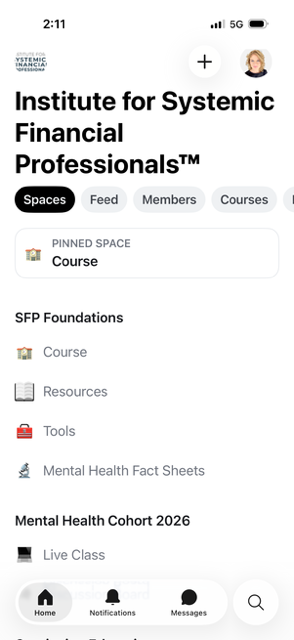

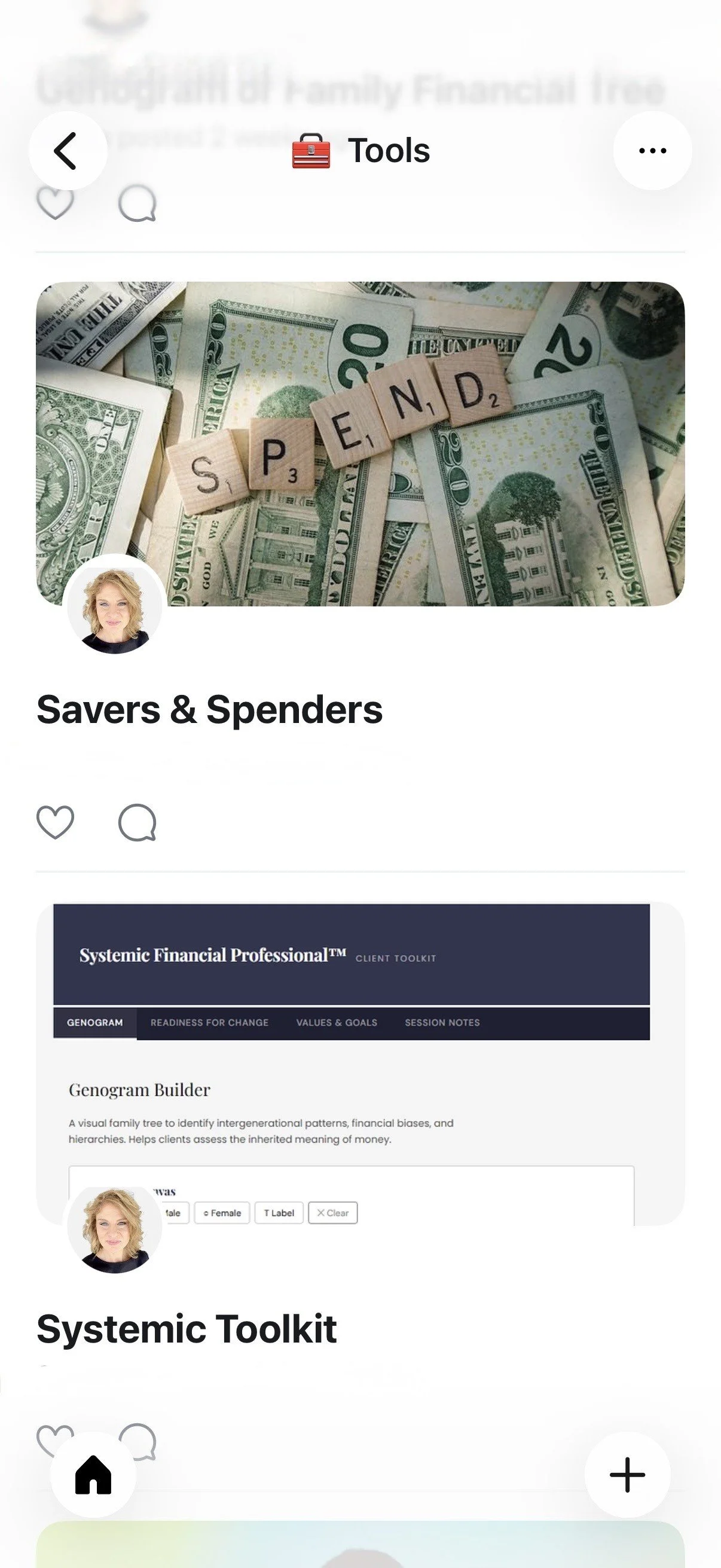
Engage with the content and your peers through expertly designed curriculum
Cherie Stueve, PhD CFP® AFC® FFC® FBS® CAP®
Senior Content Creater
“As an experienced financial professional and trainer of financial professionals, professional development programs that focus on the person and building deep, trusting partnerships fundamentally changed how I approach client relationships, training content, and adult learners. I understand why clients resist bringing their full selves to conversations and even resist implementing the best financial recommendations. It's rarely about the numbers or rate of returns. Learning to focus on family systems and communication patterns has made me be more effective in listening and learning initially, joining through active communication, and ultimately helping clients work through their real barriers to achieve important life goals. Clients leave sessions feeling empowered to confidently move forward. My conversations are deeper, partnerships form faster, my clients feel more understood, and I feel more confident navigating the emotional aspects of money. Programs like these that focus on the person and the internal process, not just the numbers, address what's really happening beneath seeking financial advice.”
SFP™ Core Competencies
SFP™ certification helps financial professionals better understand how clients perceive and interact with family dynamics. The training is appropriate for financial professionals who serve complex, multigenerational families and want to create a systems-aware relational practice focused on building financial wellness.
Financial professionals will learn to navigate complex family dynamics and emotional processes that impact financial decisions. we use a holistic, systems-oriented approach while maintaining clear professional boundaries.
Understand the Family as a System
Recognize that financial decisions are embedded within the family unit and influenced by intergenerational dynamics. Appreciate that each family member’s perspective and emotional history can shape their views on personal finances.
Map Financial Interactions
Begin client interactions with a comprehensive review that includes family history and intergenerational wealth trends. Identify recurring patterns that could impact decision-making, important family roles, communication patterns, and historical financial dynamics through the use of genograms.
Understand Differentiation of Self
Facilitate a sense of interdependence for clients so that they are not dependent nor independent of the people around them.
Develop Self-Awareness
Understand your role in the process. Cultivate a non-anxious presence and clear professional identity, even when family members introduce emotionally charged or conflicting views on wealth.
Communicate Therapeutically
Listen with your eyes to see what is not spoken. Communicate in clear, neutral terms that reflect systemic relationships rather than singling out individuals.
Navigate Conflict
Empower each client to participate actively in financial decisions while respecting the family system as a whole. Use non-blaming, systemic communication to help the family shift focus from historical conflict to future-oriented financial goals.
Manage Stress
Recognize the emotional dynamics at play. Identify signs of stress and emotional triggers in financial conversations. Use techniques to de-escalate emotionally charged discussions, ensuring that all voices are heard while keeping the focus on long-term financial goals.
Recognize Triangulation Dynamics
Identify when two family members may rely on a third (including the adviser) to resolve conflicts or mediate decisions. Learn to balance participation without taking sides or becoming an emotional crutch.
Facilitate Intergenerational Dialogue
Create safe spaces for discussing wealth that incorporate the needs and perspectives of multiple generations, acknowledging historical influences on current financial practices.
Reflect on Personal Biases
Continuously evaluate how your own family history or emotional responses might shape your professional judgment.
Recognize Boundaries
Know the limits of your role. Embrace a multidisciplinary approach and collaborative practice.
Proper Documentation
Maintain records that capture both the financial objectives and the relational context for clients. Regularly revisit these notes to assess if and how dynamics have evolved and adjust your approach to align with changing family needs.
Ethical Decision-Making
Understand basic ethical principles and code of conduct.
FAQs
-
After you are established in your daily routine, you might find yourself curious to learn more. The SFP™ is an advanced designation for financial professionals who have mastered the basics. This designation is for those driven by personal curiosity, motivation to become a better practitioner, or through a selfless desire to create wellness in others, the SFP™ is for you.
-
Systems exist across borders and cultures. Becoming a Systemic Financial Professional™ is about understanding the dynamics of complex organizations and communicating therapeutically. You can join from anywhere in the world!
-
Many will. As you demonstrate the value you’ve gained, your firm will take notice, providing an opportunity to have a conversation about how other financial professionals can level up with the SFP™.
-
The Foundations Training is currently at an intro price of $2,500. This includes 12-months of continued access to the material. Discounts are available to multiple participants from the same firm and limited scholarships exist.
-
To be certified as a SFP™, you must complete the training program, pass the exam, and agree to the code of ethics. To maintain the certification, you must meet the continuing education requirements.
-
There are an increasing number of certification and training programs in behavioral finance, psychology of financial planning, financial therapy, etc. A lot of it is really good! And, as a new certification program, we want to ensure that our vision remains at the forefront. You can obtain CE from these other organizations in addition to the required hours through the Institute for Systemic Financial Professionals™.